Introducing Instant Robot Learning
Chapters
- In every video on this page, the robot has never seen the objects before, and it learns the task instantly from just one demonstration and no further training.
Reactivity and Recovery
Real, Industrial Tasks
One-Person, One-Shot Factory
Humanoids, Too
- We’ve built a new kind of foundation model designed for instant robot learning, trained entirely in simulation without a single pixel of real-world training data.
- Just as we can prompt an LLM and get results instantly, a robot this quick and easy to teach unlocks a new era of imagination, creativity, and physical vibe coding.
Introduction
Intelligence is not about what you can already do. It’s about how quickly you can learn to do something new.
As scalable machine learning opened new horizons for robotics, we began to see remarkable examples of foundation models capable of physical tasks. Yet behind them lies an uncomfortable truth, often hidden away: painfully slow learning, with long periods of real-world data collection and training, repeated over and over again for every task. Robot demo videos don’t normally look like those above.
Perhaps instead, to build robot intelligence with truly human-like utility, we need to capture what it is that makes humans so uniquely intelligent: our adaptability, our ability to learn something new, quickly.
To get there, rather than building models that simply learn individual tasks, we can build models that learn how to learn new tasks.
At Machenta, we’ve developed the first robot foundation model which has learned how to learn new tasks instantly from only a single demonstration, whilst trained entirely in simulation without any real-world data.
Walk up to a robot. Show it once. Step back. Watch it come alive. And in that moment, the robot has learned a task instantly. We call this Instant Robot Learning.
Here’s a glimpse into our first few months at Machenta.
The Way It Is Today — And The Need For Post-Training
To understand how instant learning is different, we begin with recapping what robot foundation models typically look like today. Simply put, these models condition on images (what the robot sees) and task descriptions (what we ask the robot to do), and they predict actions (what the robot physically does). Data collection therefore involves gathering demonstrations which show what action to predict for each image and each task. And if the task can be described via language, this gives rise to a Vision-Language-Action (VLA) model.
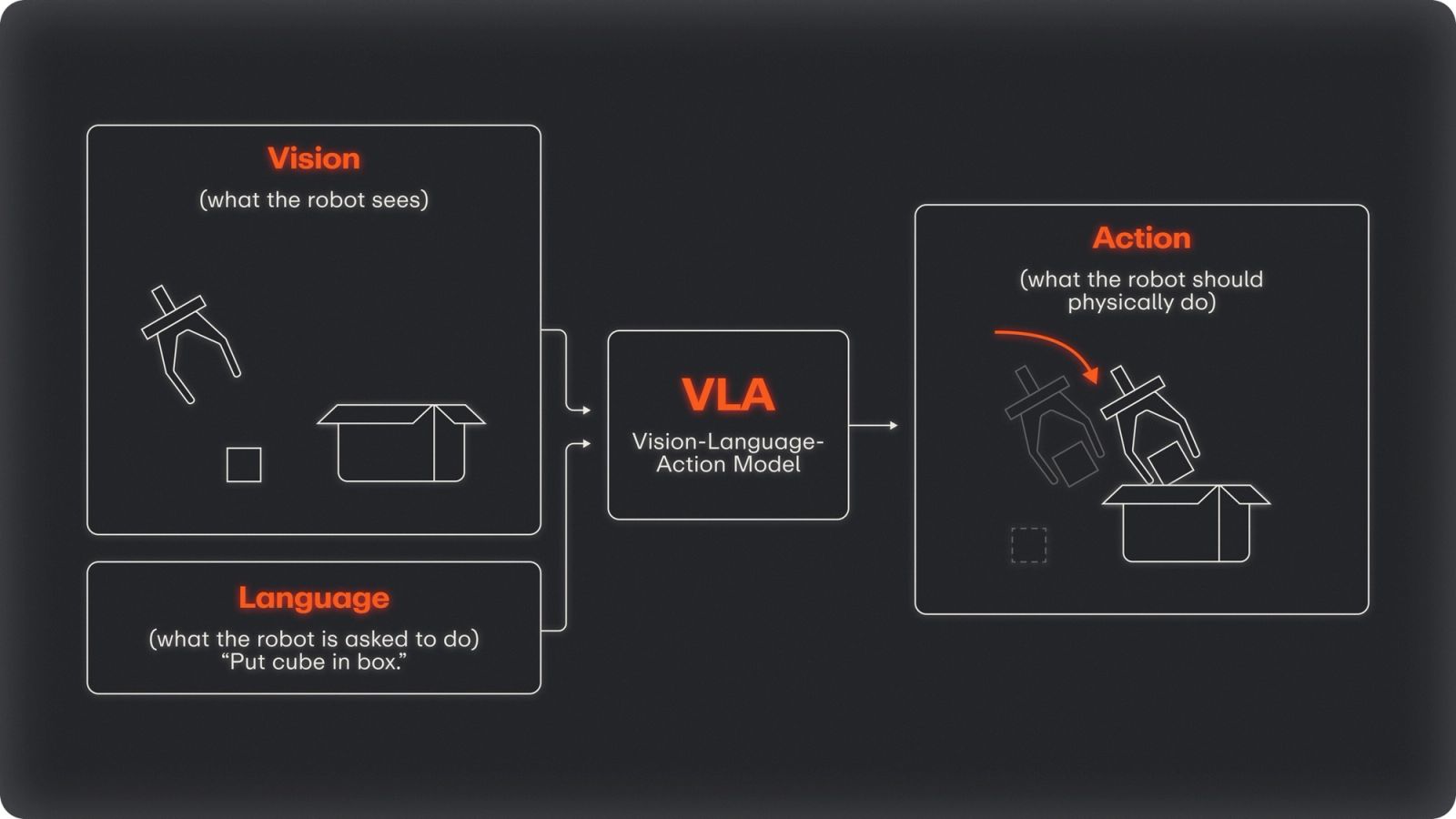
If you could think ahead about every possible object and every possible task, and then collect demonstrations for every spatial configuration and environment they could possibly be in, then in principle, a model pre-trained on this data could operate zero-shot: a robot could perform any task, from any language command, without needing any further data.
But the world is huge. This space — across all objects, tasks, spatial configurations, and environments — is, for all practical purposes, infinite.
As such, robot foundation models typically require post-training. Rather than expecting a task to already be possible with just a pre-trained model, you collect your own demonstrations to post-train the model on that one task. Diverse, pre-training data prepares the model’s representations, but task-specific, post-training data is required to actually learn each task.
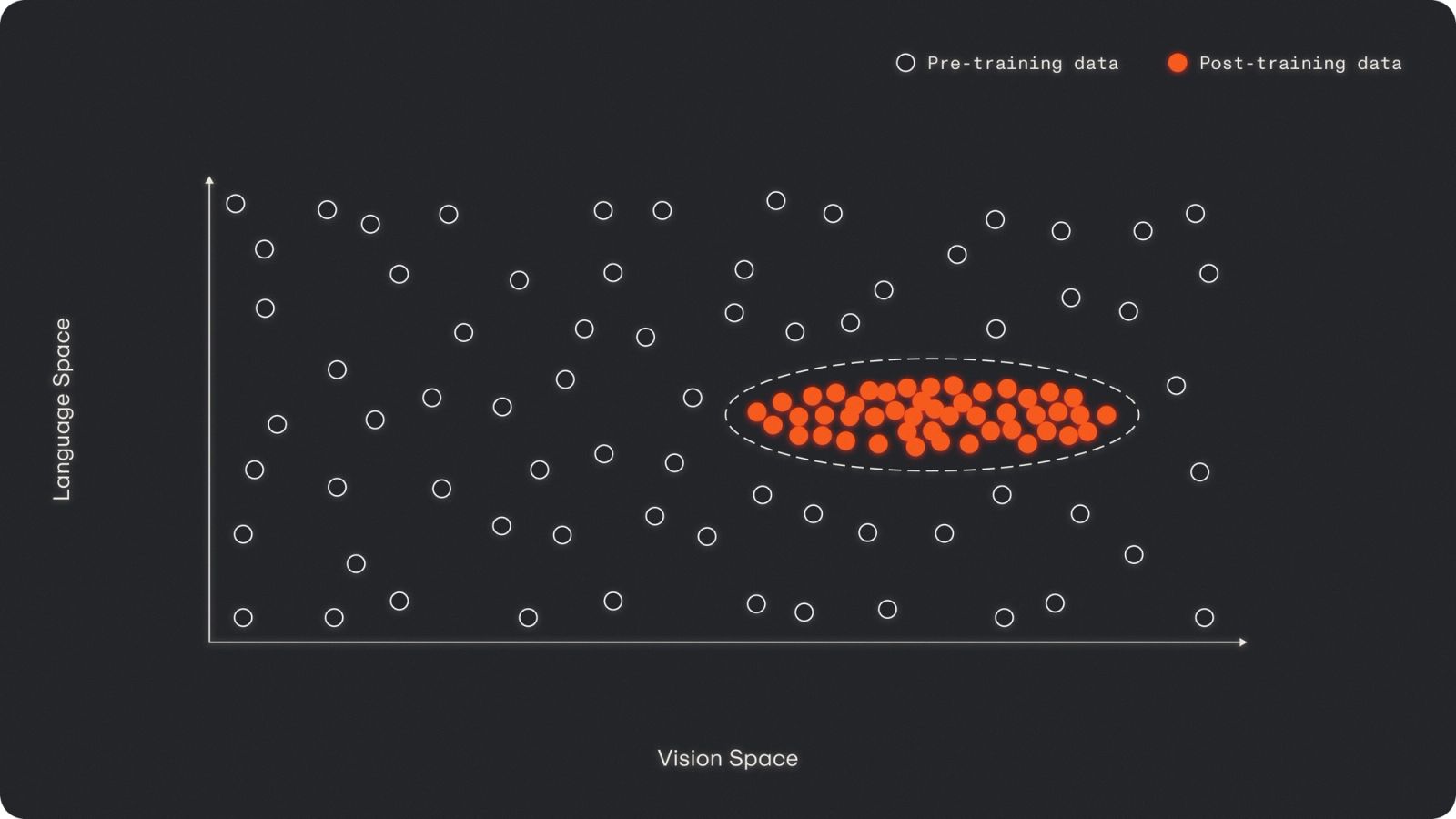
And yet post-training data collection and training can take days or even weeks. The era of post-training in robotics has not delivered physical AI with human-level adaptability and utility.
What would it take for a robot to learn as we do: instantly, from a single example?
Learning To Learn via Simulation — And The Path To Instant Learning
At Machenta, we’ve developed a model which draws upon six years of research on one-shot learning at Imperial College, and in particular, our early work on in-context learning for robotics: Implicit Graph Alignment (CoRL 2023) and Instant Policy (ICLR 2025). Recently, we’ve started to see exciting adoption of in-context learning elsewhere too, by scaling up real-world data collection efforts at Rhoda AI, Generalist, Skild AI. Our bet is that the fastest way to obtain critical diversity and scale is through simulation, reserving real data just for that single, teaching demonstration.
Conceptually, the idea is simple. As before, we condition a model on images and task descriptions. But instead of language, we use a demonstration to describe the task. We call this the vision-demo-action model (VDA).
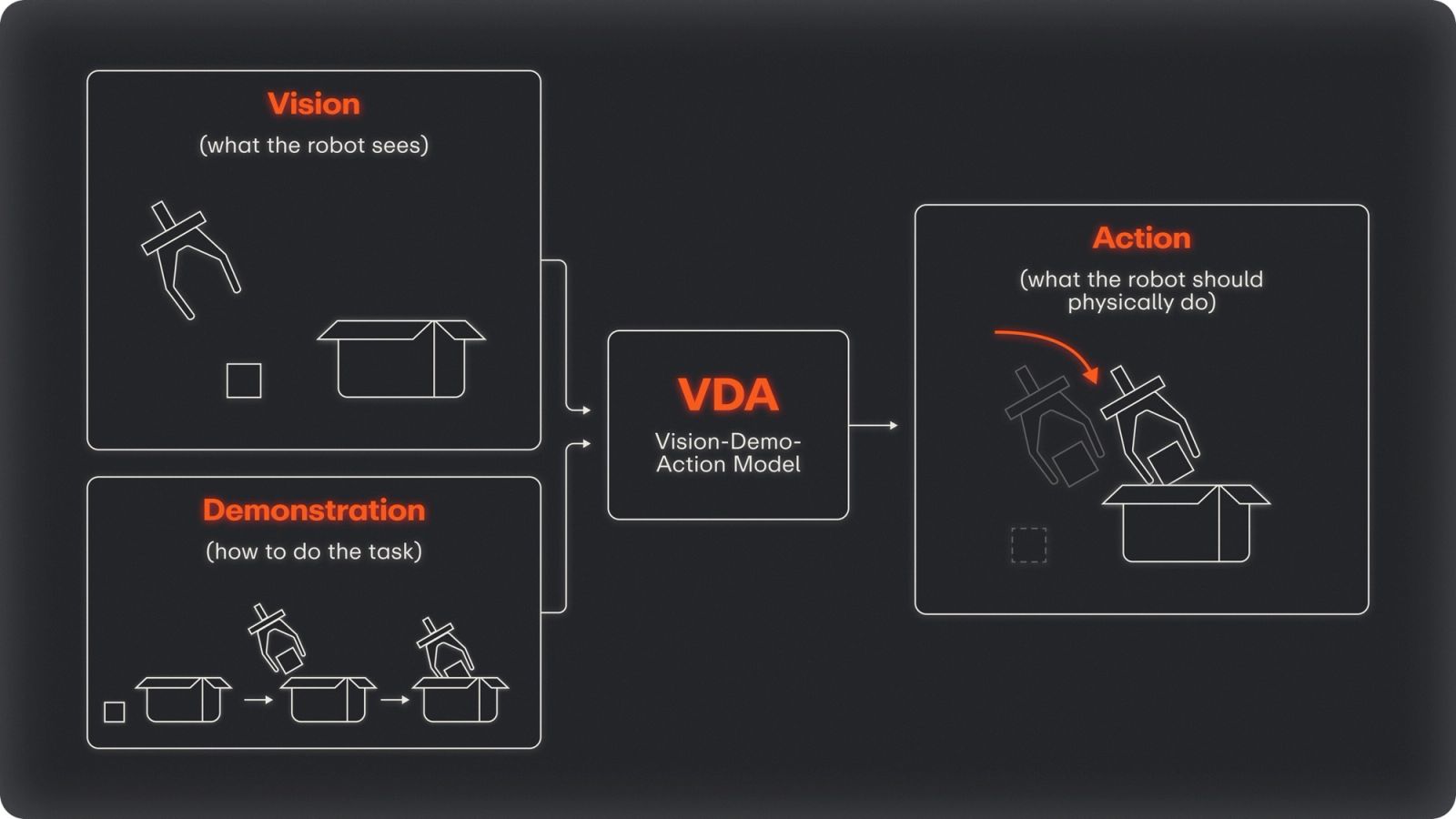
With typical VLA post-training, the weights of the model are optimised to “learn a specific task”. But to train our VDA, we generate data that captures inter-task and intra-task variations in such a way that we induce a meta-learning objective. Now the weights of the model are optimised to “learn how to learn a new task”.
But to induce meta-learning — to optimise for the task learning process itself, rather than just task memorisation — we require a vast amount of such data. Enter simulation: our own data flywheel.
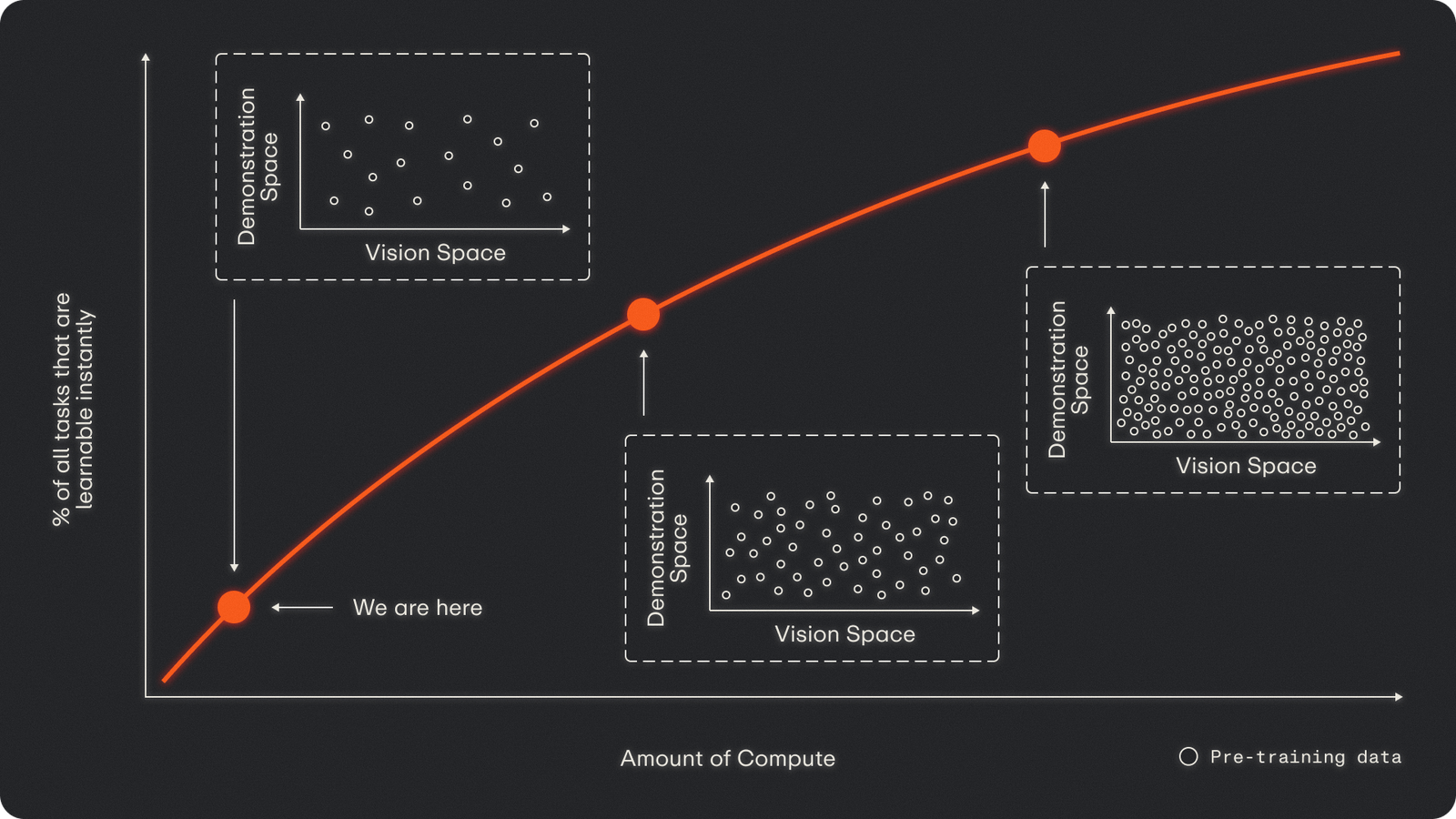
We have developed a recipe for generating simulation training data in such a way that, when we take our model to the real world and provide a single demonstration, random real tasks are often instantly learnable. And these are entirely new tasks — we are not simply creating simulations of those same tasks we teach in the real world. Our simulated world is a space of vast, random possibilities across objects, tasks, configurations, environments, demonstrations, and embodiments — a world of such diversity that learning how to learn becomes the optimal way to master it.
Three Common Questions
Why is instant learning important? At a practical level, the time and cost of post-training often doesn’t make sense economically compared to human labour or traditional robot programming. If every new task requires days or weeks of data collection and training, robots will remain too slow and too expensive to deploy at scale. Instant learning changes that. But there is a deeper reason why instant, human-like learning matters. LLMs became truly useful when we could interact with them naturally — quickly and easily, like interacting with a human. We are building that same story for physical AI.
What about the sim-to-real gap? The sim-to-real gap is a problem when simulation is used to learn a specific task. The policy uses the simulator’s version of hidden properties like camera parameters or object physics, and breaks when reality differs. But we use simulation differently: to learn the task learning function itself. Rather than memorising one environment, the model is trained across a huge range of randomised environments, so it has to learn to infer what matters from the demonstration it’s given. At test time, both the demonstration and the observations come from the same real world, so the model adapts to real conditions rather than simulated ones. To the model, reality is just one more environment to adapt to. In practice, we’ve found that the task learning function, trained purely in simulation, works very well with real demonstrations and real observations.
What about language? Language provides a much sparser description of a task than a demonstration. It can convey what to do, but not how to do it physically. After years of rapid progress in language reasoning, the hard part is now learning the physical behaviour itself, and that is where we focus. Once that behaviour is learned, our model can be extended to language-conditioned policies (as we have shown in previous work), either by using language to retrieve a matching demonstration as the prompt [Learning a Thousand Tasks in a Day], or by learning a mapping between language and demonstrations [Instant Policy]. For now, our mission is to solve the harder problem of learning how to act.
A Preview of our Model
We can now share more about what instant robot learning looks like. In all of the videos below, you will see the following: (1) somebody steps up to a robot, (2) they provide a single demonstration on objects the robot has never seen before, (3) they randomly rearrange the objects, (4) they step back, (5) the robot immediately performs the task fully autonomously. Single, uncut videos, with a demonstration immediately followed by a rollout of the learned task, is the hallmark of instant robot learning.
Instant Spatial Generalisation. Below we see a clear example of the intelligent generalisation emerging from instant learning. If you teach a robot a task, not only will it perform the task under entirely novel spatial configurations, but it will instantly react in real time to disturbances, and it will instantly recover when it fails, without you needing to show these behaviours in the demonstration.
Instant reactivity and recovery
Our model can instantly react to changes in the environment, recover from disturbances, and even redo stages of the task that have been undone.
Swapping the positions of objects
The grey container and the black scanner are swapped between the demonstration and the rollout. Our model is able to easily adapt to this with end-to-end predictions from images.
Generalist, Task-Agnostic, Cross-Embodiment Model. As well as enabling instant learning, this is a general-purpose, cross-embodiment, teacher-agnostic model:
- A single model for all tasks. In every video on this page, the same, pre-trained model is used to learn each task, without any task-specific fine-tuning. The only difference across tasks is that a different demonstration was shown.
- A single model for all robots. Across our videos you will see six different robots learning tasks, and the same model is running on all of them. Furthermore, all these robots have different camera configurations, and our model works with any of these.
- A single model for all teaching modes. Our videos show four different ways to teach robots: leader-follower, VR controller, kinaesthetic teaching, and using your own hands. It’s the same model regardless of the teaching mode.
This generality is exemplified in the video below: a one-shot, one-person factory. Three robots, each with a different gripper type, each with a different camera setup, and each with a different teaching mode, are working together, each running the same model. Within just two minutes, an entire assembly line is fully automated, a process that would traditionally require weeks of systems integration and manual robot programming.
From a factory floor to your desk at home, our model is designed to work as well on budget, hobbyist robots, just as it does on industrial robots.
Our model allows for very diverse task learning. Below is a selection of further, useful and everyday tasks that can be learned. As always, the robot had never seen any of these objects before.
Getting Creative
When LLMs became quick, easy, and intuitive to use, they unlocked an unprecedented era of imagination and opportunity for turning ideas into words. With instant robot learning, we can do the same for the physical world: turn ideas into action. One demonstration is enough to learn a new task. But if helpful, you can add more to interactively refine, clarify, or compose behaviors.
Here are some of the ways in which you can get creative when learning is instant.
Steerability
With exactly the same set of objects, you can steer the robot’s behaviour just by showing it. Here are three different ways of interacting with those objects, all of them instantly learnable. This is strong evidence that the model is genuinely conditioning on the demonstration, and not simply overfitting to a task in the pre-training data.
Clarifying through Prompt Engineering
If the task is ambiguous (even to humans) from a demonstration, further demonstrations can add clarification. In this example, an object is placed inside a small black container. Is the task to place it in “small” containers, or “black” containers? It’s ambiguous. With our model, you can add in further clarifying demonstrations as you observe the robot’s behaviour.
Object Generalisation
Our model can generalise to new objects far beyond those in the demonstrations, by combining multiple examples. Here, the robot is taught to pick up the “big white envelope” and the “small brown envelope”. Subsequently, it can pick up the “big brown envelope” and the “medium blue” envelope, showing compositional generalisation across both shape and colour.
Demo Stitching
For long-horizon tasks, rather than needing to give a perfect demonstration in one go, you can split the task up into sub-demonstrations and then stitch these together for the full task. Here, a two-stage task is taught via two demonstrations, allowing you to check the first demonstration independently before moving on to the second.
Physical Vibe Coding: The “Double Handover” Case Study. Robots with different embodiments often need different strategies to complete the same task within their kinematic limits. Because instant robot learning gives immediate feedback, finding a feasible strategy becomes a matter of simply trying alternative prompts until one works for both the robot and the model. We call this physical vibe coding: freely iterating on the physical prompt until the desired behaviour emerges. For example, tightly packing shoes into a box requires reorienting them, which is non-trivial for a robot with parallel-jaw grippers. After a few attempts, we arrived at a prompt that includes a double handover, flipping the shoe between the arms so it can be placed in the box (see video below). Each change to the prompt immediately changed the model’s behaviour, letting us quickly converge on a prompt that worked reliably. This rapid loop of demonstrating, observing and revising is only possible with instant robot learning.
Humans and Humanoids
Our model works well across different robots and teaching modes. We were curious to see how far we could push this. In early experiments, we found that our VDA model can also learn directly from human demonstrations and run on humanoid hands. While these directions aren’t our main focus, they are promising preliminary signs of how generalisable our model is.
Learning from Human Hands
Instant learning already offers a major uplift in utility over traditional post-training. A further step is being able to teach with nothing but your own hands, without any other equipment. Our early results show the model can learn tasks this way too.
Instant Humanoid Learning
Every video on this page uses the same model to learn the task, and that same model can also learn tasks on humanoids. In these videos, we show steerability on a humanoid hand: teach with two fingers, three fingers or your full hand, and the robot performs the task the same way.
What’s Next — Tripling Down on the Bitter Lesson
The videos above show what instant robot learning can do and how it can be used. But how reliably does it work? To stress-test it, we designed a few self-resetting tasks (shown below) and let the model run continuously for an hour on each over a weekend. In that time, the robots completed 74/74 block placements into a bowl, 78/78 back-and-forth screwdriver handovers, and 97/99 attempts at standing a bottle upright. (For the curious, the two failures occur at 0:46 and 0:52 in the corresponding video and are caused by a potential collision and kinematic constraints.) While these tasks are relatively simple, the results are very encouraging. But this is just the beginning, and brings us to the next phase of Machenta: tripling down on the Bitter Lesson and truly scaling.
The Bitter Lesson is, at its heart, a lesson about scaling with compute: over time, the methods that win are those that can continue to improve as more compute becomes available. Our bet is to take that lesson as far as it can go.
First, we use compute to learn intelligence from data, which is more scalable than programming it by hand. Second, we use compute to learn how to learn new tasks, which is more scalable than engineering a training pipeline for each one. And third, we use compute to generate the simulation data from which that learning ability emerges, which is more scalable than collecting it all in the real world.
Compute scales the model.
Compute scales the learner.
And compute scales the world it learns from.
What excites us is that we have barely begun to test how far this can go. The results on this page come from our first few months at Machenta, focussed largely on the fundamental research required to make instant learning work at all: finding the right architectures, training recipes, and data distributions.
We are now in a position to test a simple hypothesis: as we scale the density and diversity of simulated experience, the capacity of our models, and the compute used to train them, increasingly capable instant learners, across increasingly complex tasks, should emerge on the other side.
Stay tuned for those results.
Citation
Please cite as:
Machenta, “Introducing Instant Robot Learning”, October 2026. https://machenta.com/blog/instant-robot-learning
@article{machenta2026intro,
  author = {Machenta},
  title = {Introducing Instant Robot Learning},
  journal = {Machenta Blog},
  year = {2026},
  note = {https://machenta.com/blog/instant-robot-learning}
}